Why Early Spring Warm Spells Risk Tender Warm-Season Crops
A run of sunny, mild days can make South Carolina feel ready for summer crops, but warm afternoons do not mean cold nights are over. Tender vegetables can be damaged when temperatures fall again, and a rushed planting can cost time and healthy seedlings. The safer approach is to judge the whole weather pattern, your location, and your options for protection—not a warm spell alone.
Why a warm spell can give the wrong signal
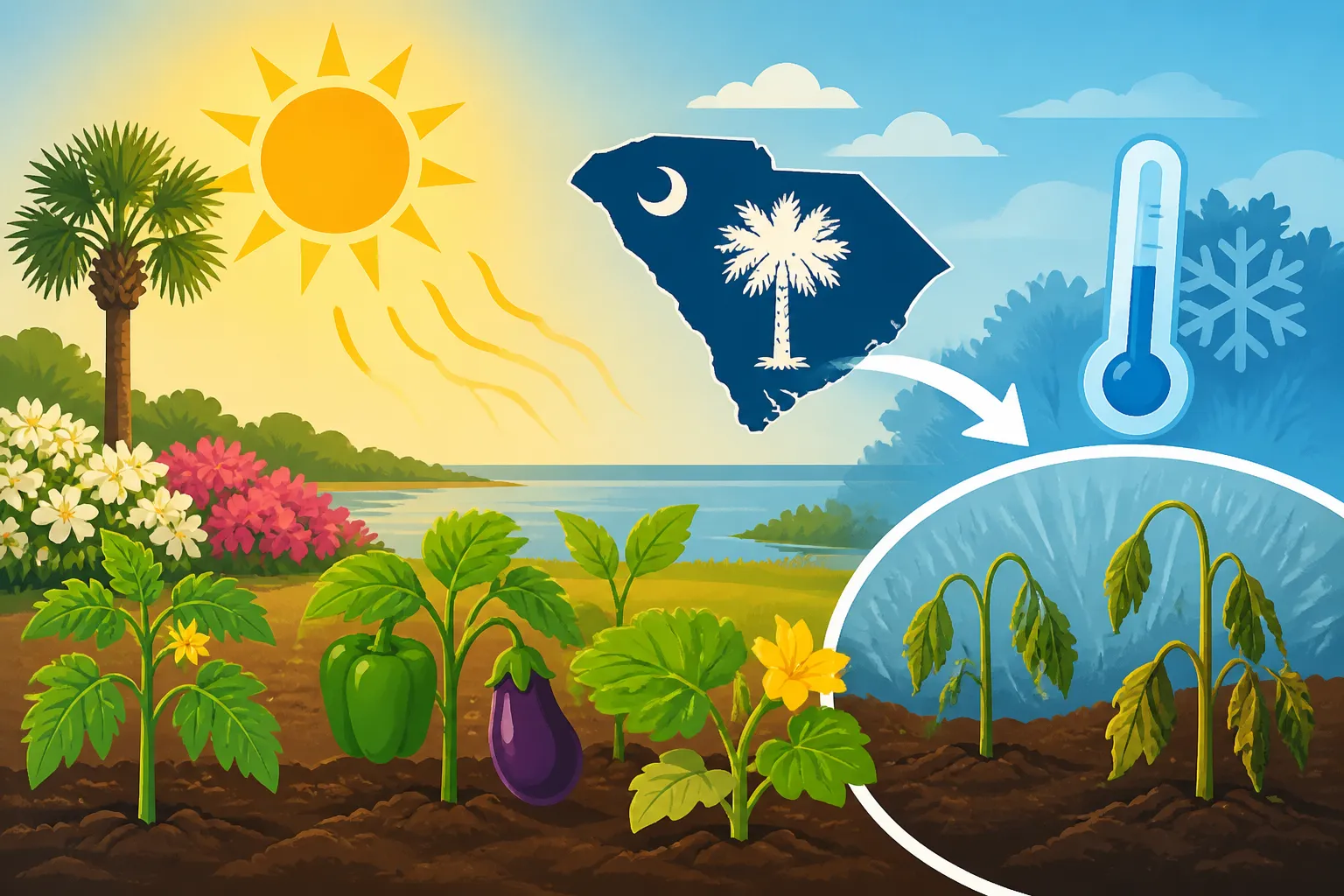
Spring weather is changeable. A stretch of bright days may warm the soil surface and encourage plants and gardeners alike to act as though the season has settled. But a brief warm spell is not the same as a lasting shift in conditions. Cold air can return, and a garden that felt comfortable in the afternoon may face a chilly night before the next warm day arrives.
That difference matters most for tender warm-season crops. These plants are intended for the warmer part of the growing season and can be harmed by freezing conditions. Their vulnerability is not cancelled by a few mild afternoons. A seedling or transplant may look vigorous at planting time and still be poorly matched to the weather that follows.
Clemson University Cooperative Extension Service advises that warm-season crops should not be planted outdoors in spring without protection until the danger of freezing temperatures is past. That guidance is useful because it focuses on the risk, not on a particular holiday, a single sunny day, or a gardener’s impression that spring has arrived.
Warm afternoons and cold nights are different signals
People tend to experience the weather while they are active outdoors. A warm afternoon makes it pleasant to work in a bed, and the soil at the surface may feel warmer than it did recently. Plants, however, remain outside after the sun goes down. They experience the night as well as the day, including a sudden drop that may not be obvious while preparing the garden.
The warmth of a daytime stretch can also make the forecast feel less threatening than it is. Check the forecast for the garden’s overnight conditions rather than relying on the afternoon high. If conditions may turn cold, postponing planting is often simpler than trying to rescue a newly planted crop.
The calendar does not settle the forecast
A general planting schedule helps organize the season, but it cannot make local weather follow a fixed date. South Carolina gardeners can use a regional calendar as a starting point, then adjust plans for the garden’s location and current conditions. South Carolina Regional Vegetable Planting Calendar and Comparing Vegetable Planting Dates Across South Carolina Regions can help put local timing in context.
Frost and freeze dates are probabilities, not guarantees. A past pattern can help with planning, but it cannot promise what will happen in a particular season. Local exposure, nearby landforms, and changing weather can all affect the conditions at an individual garden. For ways to interpret the local record, see How to Pick the Right Weather Station for Local Frost Data and Using Local Spring Freeze Normals Before Sowing South Carolina Crops.
A warm spell can be especially misleading because it arrives as a vivid, immediate experience. A calendar and local weather history are less dramatic, but they make better planning tools when used alongside the current forecast.
What makes tender crops vulnerable
Warm-season vegetables are selected for growing in warm conditions. That does not mean they can safely handle a freeze just because they are called “warm-season” crops. Tender young plants have limited ability to withstand a cold event, and a sudden shift can interrupt their growth or damage leaves, stems, or growing points.
The effect of cold depends on the conditions and the plant’s stage. A seedling that has only recently been moved outdoors may have less resilience than an established plant that has had time to adjust to its surroundings. A plant that looks unmarked after a cold night may still be stressed, while visible injury can take time to become clear. Avoid assuming that a crop is fine just because it is standing upright the next morning.
Planting adds another stress
Transplanting changes a plant’s surroundings all at once. A seedling leaves a sheltered growing space and enters a garden with different light, airflow, soil moisture, and temperature swings. The plant needs to adjust to those conditions. If cold weather arrives soon after planting, it has to cope with that change while also facing a temperature stress.
Direct-sown crops have their own vulnerabilities. Seeds and young seedlings are exposed to the conditions of the bed, and their progress can be uneven when the soil and weather fluctuate. Planting too early may leave seeds waiting in conditions that are not suitable for steady growth, or may expose emerging plants to a return of cold.
The practical point is not that every tender plant will be lost after any cool night. It is that planting during a warm spell can create avoidable risk. When the weather is unsettled, keeping a plant in a protected setting or delaying sowing may preserve the option to plant under better conditions.
Cold injury may not look the same on every plant
Cold damage can appear as wilted, discolored, water-soaked, or collapsed tissue, but symptoms vary with the crop and the conditions. Damage may be limited to exposed leaves, or it may affect the growing tip and a larger portion of the plant. A plant may also appear stressed without having suffered a fatal injury.
Wait for conditions to stabilize before deciding what to do with a damaged plant. Check whether new growth appears and whether the central growing point remains intact. Avoid removing a plant immediately based only on a single damaged leaf; at the same time, do not assume a severely affected plant will recover. If the crop is unlikely to resume healthy growth, replacing it after the weather is suitable may be more practical than continuing to nurse it.
Cold injury can be confused with other problems, including transplant stress, dry soil, waterlogged soil, or physical damage. Consider what changed recently and inspect the plant and surrounding soil before responding. For wider troubleshooting, see Troubleshooting Poor Harvests in South Carolina Home Gardens.
Why South Carolina gardens can differ
South Carolina gardeners do not all experience spring in the same way. A planting window suitable for one part of the state may not be a safe signal for another. Even gardens in the same broad area can have different exposures: a sheltered bed near a building may behave differently from an open plot, while a low spot may hold cold air under some conditions.
This is why statewide advice is best treated as a framework rather than a personal forecast. Regional schedules can help you decide what to watch for, but they do not remove the need to check conditions where you garden. Vegetable Planting Dates for Your South Carolina County is a useful companion when narrowing a broad schedule to a local area.
Start with your garden’s setting
Notice how the bed behaves through the day and night. Does it receive direct sun early, late, or for much of the day? Is it exposed to wind, or sheltered by a structure or plantings? Does cold air seem to settle there compared with nearby parts of the yard? These observations do not replace a forecast, but they help explain why the same weather can affect different beds in different ways.
A site that warms quickly on a sunny day may also cool quickly after sunset. Soil and air do not always warm or cool at the same pace, and a surface that feels comfortable at midday does not prove the bed is safe overnight. When conditions are uncertain, use the forecast and the local history together rather than treating the feel of the soil as a test.
Sunlight planning matters for the growing season overall, but it is not a shield against freezing weather. A sunny site can help plants grow when conditions are appropriate; it cannot guarantee that a tender crop will avoid cold injury. Planning Sunlight Exposure Across Seasons in South Carolina Beds and How Much Daily Direct Sun South Carolina Vegetables Require can help with the separate question of whether a bed has suitable light.
Use a local timeline without treating it as a promise
Local frost records can help frame the season, but a likely date is not a forecast for your yard. If a regional or local frost estimate is part of your planning, remember that it describes probability and varies from year to year. It should inform decisions rather than set a hard deadline.
For a broader view of seasonal timing, South Carolina Frost Freeze Timelines and Growing Season Planning explains how frost and freeze risk fit into garden planning. Gardeners in different parts of the state may also benefit from location-specific context, such as Upstate Spring Freeze Timelines for Foothill Garden Beds or Last Spring Frost Dates for Coastal Plain Vegetable Gardens. Use the material that matches your region, then check current weather before setting out tender crops.
Do not use a holiday or a familiar annual routine as a substitute for local conditions. The weather can shift from one spring to another, and a date that worked in a previous season does not guarantee the same outcome this time.
How to decide whether to plant, wait, or protect
A good decision starts with the crop and the weather risk, not with the urge to fill every bed as soon as the first warm days arrive. Ask whether the crop is tender, whether it will be outdoors without protection, and whether the forecast suggests a return of freezing conditions. If the answer to those questions points to risk, delay or provide suitable protection rather than assuming the warm spell has settled the matter.
A practical decision sequence
- Identify the crop and its sensitivity. If it is a tender warm-season crop, plan around the possibility of cold injury rather than assuming it can withstand a late cold return.
- Check the forecast for the garden location. Pay attention to overnight conditions and any forecast change, not only the daytime warmth.
- Consider the local pattern. Use regional guidance and local frost information as context, while remembering that they describe risk rather than guarantee a specific outcome.
- Decide whether protection is realistic. A cover or other shelter helps only if it can be put in place appropriately and managed when conditions change.
- Choose the lower-risk option. When a freeze is possible and protection is uncertain, waiting is usually the simpler choice.
- Reassess before planting. Weather changes; a decision made during one warm stretch may need to change if the forecast turns colder.
This process is deliberately flexible. It does not promise a perfect planting date, but it helps prevent a common mistake: treating a pleasant afternoon as evidence that tender crops are safe outdoors.
When waiting is the better plan
Waiting is sensible when the forecast is unsettled, a cold event is possible, or the garden has a history of staying colder than nearby areas. It can also be the right decision when you lack a dependable way to protect the plants. Seed packets, transplants, and empty beds may feel like an invitation to plant immediately, but a short pause can reduce the chance of losing the work.
Waiting does not necessarily mean losing the entire season. Many garden plans can be adjusted. You may start a crop later, shift another crop into the bed temporarily, or choose a succession plan that keeps the garden productive. Planning Your Year-Round South Carolina Garden Calendar and Staggering Garden Sowings in Spring and Fall for Steady Yields offer approaches for making room for changing conditions.
When protection may help
Protection can reduce exposure to cold, but it is not a guarantee. Its effectiveness depends on the material, how it is installed, the weather, and whether the cover is maintained as conditions change. A covering that shifts, leaves gaps, or rests heavily on tender growth may not provide the shelter a gardener expects. Protection also needs attention as temperatures rise; a cover left in place in bright conditions may create an unsuitable environment for the plants beneath it.
Choose protection based on the actual risk and what you can manage. Do not use a cover as a reason to ignore a serious forecast or to plant far ahead of appropriate conditions. If you cannot monitor the bed or secure the shelter, postponing may be the more reliable option. Protecting Early Starts From Late Spring Freezes in South Carolina and Protecting Tender Warm-Season Crops from Spring Freezing Weather focus on this part of the decision.
Plan planting around more than air temperature
Air temperature is an important signal, but it is not the whole planting decision. Soil condition, moisture, drainage, and the plant’s stage all affect how well it gets established. A warm afternoon cannot make a wet, compacted, or poorly prepared bed suitable. Likewise, an apparently ready bed cannot make tender crops safe if freezing risk remains.
Check the bed before setting out transplants
Before planting, look at the soil rather than relying only on the surface. Soil that is too wet can be difficult to work and can leave roots in poor conditions. A bed that is dry or unevenly moist may also make establishment more difficult. Avoid forcing the planting schedule when the bed is not ready; preparation can happen while the weather risk passes.
Raised beds and containers may warm or dry differently from in-ground beds, but they are not automatically protected from cold. Their exposure to surrounding air can make them more affected by changing conditions. A pot can be moved to shelter more easily than a large garden bed, but moving it is useful only if the shelter actually reduces exposure and the plant can be cared for there.
For background on site preparation and soil, see Prepping South Carolina Raised Beds Ahead of Early Spring Sowing and Building and Filling Raised Beds in South Carolina Gardens. For containers, Planning Raised Beds and Containers for South Carolina Crops can help you weigh the different trade-offs.
Prepare transplants gradually
A plant raised indoors or in a protected environment needs time to adjust before it is left outside in full conditions. The transition should be gradual, with attention to sunlight, wind, and the forecast. Moving a tender plant directly from shelter into a sudden change in conditions can add stress even when freezing weather is not expected.
Acclimation does not make a tender crop frost-proof. It helps the plant adapt to outdoor conditions, but it is not a substitute for waiting until freezing danger has passed or for providing protection when conditions warrant it. If the forecast changes during the adjustment period, keep the plant sheltered or pause the transition rather than pressing ahead.
Keep plants in an appropriate environment while waiting. Avoid leaving transplants in a place where they can dry out, overheat, or be exposed to an unexpected cold night. The goal is to hold them in healthy condition so they are ready to go into the bed when the weather and site are suitable.
Keep a backup plan
A backup plan makes weather delays less frustrating. You might keep a few spare seedlings, reserve a protected spot, or plan a cool-season crop for a bed that is not yet ready for tender vegetables. A flexible layout also makes it easier to replace a crop if cold injury occurs.
Do not sow or transplant every seedling at once if a staggered approach better fits your space and risk tolerance. Succession planting can spread the work and the potential harvest across more than one planting. It cannot eliminate cold risk, but it can reduce the consequences of one poorly timed decision. Coordinating Direct Seeding and Transplants Across South Carolina explains how different planting methods can fit into one plan.
Common mistakes during early spring warm spells
Early spring can create pressure to act. Seedlings are ready, the garden center has plants, and a run of warm days makes waiting feel unnecessary. Most avoidable errors come from treating one signal as decisive instead of considering the crop, the forecast, and the conditions together.
Planting by the warmest day
A warm afternoon is a snapshot, not a season. It may tempt you to set out plants before checking the overnight forecast or the outlook for the following days. Make a habit of checking conditions before planting, and be willing to change course if the forecast shifts.
This is especially important when several mild days have made the garden seem settled. A return to cold weather can still occur after a pleasant stretch. The forecast is not perfect, but it is more useful than assuming that recent warmth will continue.
Confusing “warm-season” with cold-tolerant
The name describes the kind of season these crops are suited to; it should not be read as a promise that young plants tolerate freezing conditions. A tender crop can be harmed before the season feels fully warm to a person. Match the crop to the conditions it will actually face.
If you are unsure whether a particular crop is tender, check reliable crop-specific guidance before planting it outdoors. Avoid transferring a recommendation for one vegetable to another simply because both are grown in summer.
Treating protection as automatic insurance
A cover can help, but protection is not a substitute for good timing. Covers need to be suitable for the situation and placed securely. They can also require adjustment as temperatures and sunlight change. If you cannot manage those details, planting later can be the safer and less labor-intensive choice.
Be cautious about relying on an improvised shelter that has not been secured or that may damage plants. The aim is to reduce exposure without creating another problem. For sudden cold events, Installing Cold Frames to Shelter Backyard Greens During Sudden Dips discusses a specific approach, while Protecting Potted Plants During Sudden Cold and Heat Spells is relevant to movable containers.
Assuming a damaged plant is either fine or finished
After a cold event, a gardener may dismiss damage because the plant is still upright, or remove it immediately because some leaves look poor. Neither response is always right. Give the plant a chance to show whether healthy growth continues, and consider the condition of its central growing point and stem.
If the plant is clearly declining, replacing it may be more practical than spending time on one that cannot recover. If injury is limited, continued care may be reasonable. Avoid making a large change based on one visual sign without considering what happened and how the plant responds afterward.
Following another gardener’s date without checking your own site
Advice from a nearby garden can be helpful, but differences in exposure, elevation, shelter, and local weather mean another person’s timing may not transfer directly. Use recommendations as a prompt to investigate, not a guarantee that your own bed is ready.
The same caution applies to old notes from your own garden. They are useful records, but a past outcome does not predict every spring. Use them alongside current forecasts and local information.
A steadier way to start warm-season planting
The goal is not to avoid every bit of spring risk. It is to make a deliberate choice about how much risk to accept. A gardener with a reliable way to protect plants may choose a different plan from someone who cannot monitor a bed or move containers. Both can make sound decisions if they consider the likely conditions and the consequences of being wrong.
Start by separating preparation from planting. You can plan beds, organize supplies, check soil, and prepare supports while waiting for the weather to become suitable. That way, a delay does not feel like lost time. When the forecast and local conditions align, you can plant without having to rush through the work.
Keep simple notes about what you planted, where it went, what the weather did, and how the crop responded. These observations can help you make better choices in later seasons, especially when paired with regional schedules and local frost information. Notes are most useful when they distinguish what happened in your particular garden from a broad recommendation.
A useful seasonal plan has room for change. Leave space for a later planting, choose crops that fit the conditions, and avoid putting every tender plant at risk during the first warm spell. If early cold returns, protect what you can, assess any injury, and adjust the plan rather than assuming the season is lost.
For a broader planting strategy, Managing Seasonal Crop Transitions in South Carolina Gardens can help connect spring planting with later crops. When the question is specifically whether a warm-season crop can go outdoors, When Outdoor Frost Danger Passes for Warm-Season Vegetables offers additional timing context. The most dependable decision still comes from combining that background with current local weather.
The practical takeaway is straightforward: treat early spring warmth as an invitation to prepare, not proof that tender crops are safe. Check the forecast, account for your garden’s setting, and wait or protect plants when freezing risk remains. A little patience can spare seedlings from a setback and leave you better positioned to plant when conditions are more dependable.
Frequently Asked Questions
Can I plant warm-season crops after several warm days?
Warm days alone are not enough to establish that tender crops are safe outdoors. Check overnight conditions, the forecast, and local planting guidance. If freezing danger remains, wait or provide suitable protection.
Does a frost date guarantee that a freeze will not happen afterward?
No. Frost dates describe probability, not a fixed promise. Weather varies from year to year, so use local frost information as context and continue checking the forecast.
Will covering tender plants make an early planting safe?
A cover may reduce exposure, but it is not a guarantee. Its usefulness depends on the conditions and how it is installed and managed. If protection is uncertain, delaying planting is often the simpler choice.
What should I do if a warm-season plant is damaged by cold?
Check the plant after conditions stabilize and look for continued healthy growth. If the growing point or much of the plant is severely affected, replacing it may be more practical. Avoid deciding from one damaged leaf alone.
Sources
- Clemson University Cooperative Extension Service — Planning a Garden | Home & Garden Information Center (checked November 15, 2026)
Disclaimer
This article is for general informational purposes only and does not constitute professional advice. Laws, prices and regulations vary by location and change over time. Consult a qualified professional for guidance on your specific situation. South Carolina Gardening Guide is not a government agency and is not affiliated with any university extension, state department of agriculture or other government agency.