Comparing Vegetable Planting Dates Across South Carolina Regions
A planting date that works near the coast may put seeds or transplants at risk in the Upstate. South Carolina gardeners need to account for regional differences in frost, soil warmth, summer heat, and fall cooling—not just the calendar. This comparison explains how planting windows shift across the state and how to adapt them to your own garden.
Why South Carolina Planting Dates Vary by Region
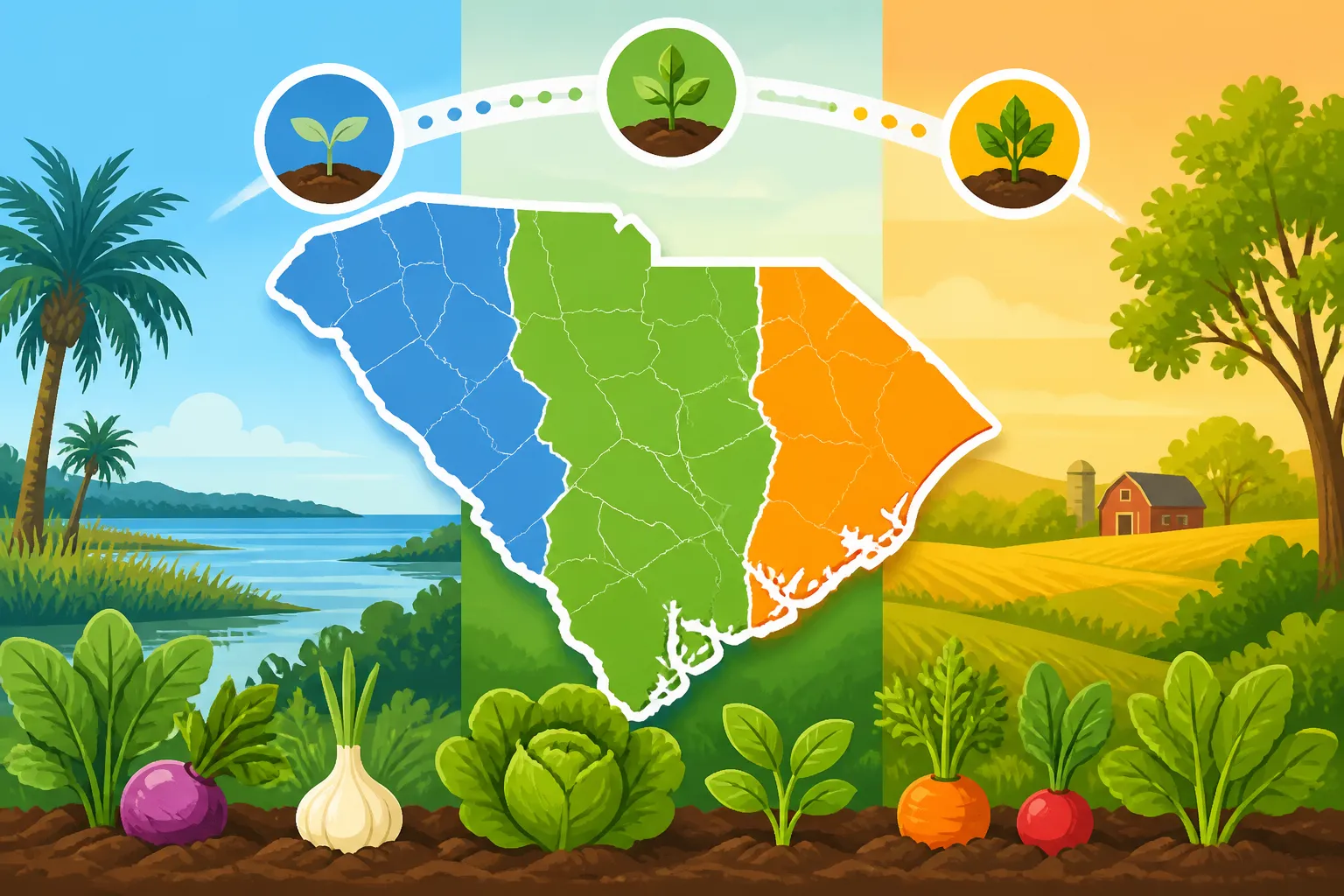
South Carolina’s growing season is not one uniform stretch. Coastal areas generally warm earlier in spring and stay warm later in fall. Inland areas tend to have greater exposure to late spring freezes and earlier fall cold, especially at higher elevations. Between those patterns, the Midlands and much of the Piedmont have their own mix of warming soil, local frost risk, and summer heat.
That variation affects more than the last spring frost. A warm afternoon does not guarantee that soil is ready for a heat-loving crop, and an early warm spell does not rule out another cold night. Fall planting has a similar complication: air temperatures may still feel like summer while the days left for a crop to mature are already becoming limited.
For planning, it helps to think in terms of regional windows, not a single statewide date. A window is a period when conditions are becoming suitable, with the exact day depending on the crop, your site, and the weather that year. A sheltered garden in town may warm sooner than a low-lying plot nearby. A north-facing bed or an exposed ridge may remain cool after a more protected site has started warming.
Three broad patterns are useful:
- Spring planting usually begins earliest in the coastal region, progresses through the central parts of the state, and is generally later in the Upstate.
- Fall planting generally starts earliest inland, where summer crops must be cleared before earlier fall cold, and later toward the coast, where warmth can linger.
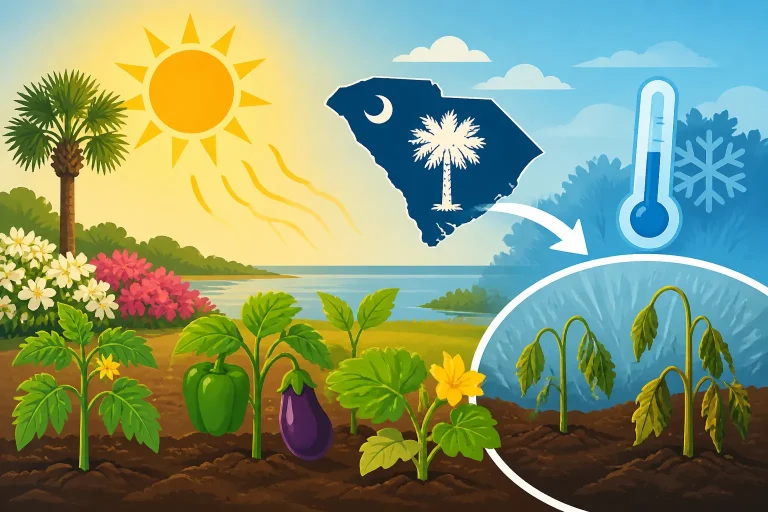
- Heat-sensitive crops often face a short or challenging window in the middle of summer, even where the frost-free season is long.
For a statewide overview of crop groups and seasonal planning, see South Carolina Vegetable Seasons: Warm vs Cool Crops. For more region-by-region calendar detail, South Carolina Regional Vegetable Planting Calendar can help organize the broad pattern into a local plan.
How the State’s Regions Change the Spring Calendar
Spring planting decisions hinge on several conditions that do not arrive at the same time: frost risk, soil temperature, and the crop’s tolerance for cold. Coastal, central, and Upstate gardens differ in how those conditions line up.
Coastal gardens
The coast tends to offer the earliest opportunity to begin spring sowing and transplanting. That does not mean every warm-season crop should go out at the first sign of mild weather. Coastal nights can still turn cold, and an exposed bed may be affected by wind or a brief cold spell even when nearby gardens are more protected.
Cool-season crops often make good use of the earlier spring window. Peas, carrots, leafy greens, and other crops that prefer cooler growing conditions can be sown or planted while temperatures are still moderate. The challenge is not to wait so long that spring warmth quickly pushes crops toward bolting, poor quality, or a shortened harvest.
Warm-season vegetables need a different signal. Tomatoes, peppers, squash, beans, and other tender crops should go out when frost risk has receded and conditions are warm enough for steady growth. A mild coastal afternoon is not enough by itself: chilly soil can slow roots and make a newly planted crop struggle. For tomatoes in particular, Coastal Spring Tomato Planting Schedule for Home Gardeners focuses on the coastal timing considerations.
Midlands and central areas
In central South Carolina, spring conditions often fall between the coastal and Upstate patterns, but the region is not perfectly uniform. Urban and low-elevation locations may warm earlier than more exposed or higher sites. Cold air can also collect in low spots, so a garden’s position matters as much as a broad regional label.
Cool-season crops can take advantage of the end of winter and the beginning of spring, but the most suitable window can be brief for crops that dislike warmth. If you sow too early, cold soil may delay germination. If you wait until the ground and air are consistently warm, some cool-season crops may have little time to mature before heat arrives.
Warm-season planting should be paced rather than treated as one big spring event. Gardeners can wait for safer conditions for tender crops while continuing to sow or set out crops that tolerate cooler conditions. The general approach is covered in South Carolina Spring Planting Schedule: Sowing After Frost. For local planning, compare the guidance for your county with observations from a nearby weather station.
Upstate gardens
Upstate gardeners generally need more caution in spring than gardeners closer to the coast. The region’s elevation and local terrain can mean colder nights or later warming, and conditions may shift over short distances. An early warm spell can be followed by frost, so a few sunny days should not be treated as proof that tender plants are safe outdoors.
Cool-season crops are often the first group to plan for, but their timing still depends on workable soil and the crop’s needs. Some can be sown before the last spring frost; others are better planted when the bed is warmer or when transplants can establish without severe cold. Tender warm-season crops should wait for a safer combination of low frost risk and warm soil.
The Upstate calendar is especially sensitive to site differences. A sunny, sheltered yard may be ready before a nearby exposed garden. Gardeners in foothill or higher-elevation locations should avoid applying a lower-elevation planting schedule without checking its assumptions. Upstate Warm-Season Planting: Waiting for Freeze Risk to End discusses why delaying tender crops can be worthwhile.
Compare regions by crop group
The table gives a useful starting point, but it is not a date chart. Use it to decide which regional schedule to investigate and what conditions to check before planting.
| Crop group | Coastal region | Midlands and central areas | Upstate |
|---|---|---|---|
| Cool-season crops in spring | Often the earliest start; avoid delaying until heat sets in | Start as soil becomes workable; watch for the transition to warm weather | Spring opportunity may arrive later; use cold-tolerant crops and local conditions |
| Tender warm-season crops in spring | Can usually be considered earliest, but wait for safe conditions and warm soil | Usually follows coastal timing; check local frost risk and soil warmth | Generally requires the most spring caution, particularly in exposed or higher sites |
| Cool-season crops in fall | Often planted later because warmth lingers | Usually begins after the worst heat eases, with timing adjusted to crop maturity | Often needs an earlier start to allow crops to mature before colder weather |
| Late warm-season succession crops | Longer warm period may allow more options, depending on crop and available time | Choose crops with enough time to mature before fall cold | Use a shorter, carefully planned window and account for earlier cooling |
The broad comparison is more reliable than assigning one date to every garden in a region. For specific county-level guidance, see Vegetable Planting Dates for Your South Carolina County.
How Fall Planting Windows Shift Across the State
Fall calendars often seem counterintuitive. It is tempting to assume that a region with a longer warm season can wait longer to plant every fall crop. In practice, the right start depends on the crop’s days to maturity, the heat it must endure after sowing, and how much suitable growing weather remains before cold arrives.
Inland gardens usually need to plan earlier than coastal gardens for fall crops that require time to develop before freezing weather. The Upstate may have the least room for delay, while the coast can often continue growing crops later into the season. But a later coastal window does not mean planting can be postponed indefinitely: very warm soil and hot air can make germination and establishment difficult for cool-season seedlings.
Start with the harvest date and work backward
For a fall crop, begin with the conditions the crop can tolerate at harvest and the time it needs to reach that point. Then work backward to decide when to sow or transplant. Seed packets and plant labels can help estimate maturity, but those estimates are not guarantees. Heat, moisture, soil conditions, and transplant stress can all affect growth.
Direct-sown crops may need extra attention because seeds must germinate and establish in warm soil. Transplants can give some crops a head start, but young plants still need protection from heat and drying conditions. A schedule should leave room for establishment, not just count backward from the expected harvest.
For a more detailed overview of fall timing, see South Carolina Fall Planting Windows for Cool-Season Vegetables. Gardeners planning successive sowings can also use Starting a Late-Season Vegetable Garden for a Fall Harvest to consider how a late start changes crop choices.
Match the crop to the region’s remaining season
Quick-maturing crops may fit a later planting than crops that need a longer period to size up. Root crops, leafy greens, and brassicas do not all respond to heat and cold in the same way, so avoid treating “fall vegetables” as one planting group.
A practical way to plan is to divide fall crops into three categories:
- Fast crops: These may suit a later sowing if there is enough time for germination and harvest before conditions become unsuitable.
- Longer-season crops: These usually need an earlier start, often as transplants, so they can develop before fall cold.
- Crops that tolerate cool weather well: These may continue producing after temperatures drop, but they still need time to establish and grow before the coldest weather.
In the Upstate, the margin for a late sowing is generally narrower. In central areas, the calendar can be intermediate, but local elevation and exposure matter. Along the coast, the later end of the fall window may be more forgiving, though late-season heat can still hinder germination.
Make room for fall crops before summer crops are finished
Fall planting often requires removing or reducing summer crops before they appear completely spent. Waiting for every warm-season plant to stop producing can leave too little time to establish the next crop. If a bed is still productive, consider whether part of it can be cleared, or whether seedlings can be started elsewhere for transplanting later.
This is a calendar and space decision as much as a weather decision. A short-term crop may fit between rows of a slower crop, while a cleared bed can be prepared for a fall succession. The goal is to avoid a long gap between summer harvests and fall establishment. Managing Seasonal Crop Transitions in South Carolina Gardens offers a broader approach to moving beds from one season to the next.
Choose a Calendar That Fits Your Garden, Not Just Your Region
Regional schedules are useful starting points, but a garden can be warmer, colder, wetter, or drier than the area represented by a calendar. Before using a recommendation, check what it assumes about your location and planting method.
Use frost information carefully
Frost dates are probabilities based on historical observations, not promises about what will happen in a particular year. A date that represents a likelihood at one weather station may not describe a garden a few miles away, especially where elevation, slope, buildings, or nearby water alter local conditions.
Look for a station with a location and elevation that resemble your garden. Then treat its frost information as one planning tool rather than a planting instruction. How to Pick the Right Weather Station for Local Frost Data explains how to choose data that better reflects a local site.
When a crop is vulnerable to frost, consider both the estimated end of spring frost risk and the forecast for the coming days. A calendar can suggest when to begin watching; it cannot replace checking actual weather. Tracking Spring Freeze Forecasts Before Sowing South Carolina Beds provides a useful reminder to monitor conditions as planting approaches.
Factor in soil warmth
Soil can remain cool after daytime air temperatures become pleasant. That matters for seeds that need warm soil to germinate and for transplants whose roots need to establish. Heavy or wet soil may also warm and dry more slowly than a lighter, well-drained bed.
Rather than relying on an isolated warm afternoon, look for a sustained pattern that suits the crop. If the bed is still cold or saturated, waiting can be better than forcing a planting date. For fall sowing, the reverse can be true: hot, dry soil may make it hard to establish cool-season seed, so shade, moisture management, or starting transplants separately may help.
Account for sun, shade, and exposure
A garden that receives strong afternoon sun may heat up sooner than a shaded site. A sheltered spot near a building may avoid some wind and cold exposure, while an open ridge or low pocket may be more vulnerable to temperature swings. Nearby pavement can create a warmer microclimate, but the effect may also increase heat stress in summer.
Record what happens in your garden rather than assuming that every bed on the property behaves alike. If one part of the yard consistently warms sooner, use it for earlier plantings only when the crop’s other needs are met. Do not use a warm microclimate as a reason to ignore a forecast freeze.
Adjust for seed and transplant method
Direct sowing and transplanting can give different results even when done on the same date. Seeds must germinate and grow in place, while transplants have already developed some growth before they reach the bed. Transplants may help crops that benefit from an early start, but they can be set back if roots are disturbed or if they meet unsuitable weather.
A useful comparison is Direct Sowing vs Starting Seeds Indoors for Home Beds. For any crop, follow the seed packet or plant label for its specific growing requirements, and make sure indoor-started seedlings are prepared for outdoor conditions before setting them out.
Build a Regional Planting Plan by Season
A workable calendar is more than a list of dates. It links crop choice, bed availability, weather, and expected harvest. A simple seasonal plan can keep spring and fall decisions from becoming last-minute guesses.
Make a spring sequence
Start with crops that tolerate cooler conditions and can be planted before tender crops are ready. Keep separate notes for direct-seeded crops and transplants, because they may have different suitable windows. As spring progresses, check the forecast and soil warmth before setting out crops that are sensitive to cold.
Rather than planting every warm-season crop on the first suitable day, consider whether a staggered approach would reduce risk. If one planting is damaged or delayed, a later planting may still have time to produce. The best spacing between sowings depends on the crop and season, so use crop-specific recommendations rather than copying one interval across the garden.
Plan summer around heat and harvest
South Carolina summers can be hard on crops that prefer moderate temperatures. The coast may offer a longer warm season, but long periods of heat and humidity can still disrupt flowering, fruit set, and quality. Inland gardens may also face intense heat before fall planting can begin.
If a crop tends to struggle in hot weather, its spring planting date matters because it determines how much production is possible before peak heat. Keep an eye on signs that a crop is slowing down rather than expecting it to perform continuously through summer. Choose varieties suited to the crop and season, and avoid assuming that a longer frost-free period means every vegetable will produce well all summer.
Reserve time for fall crops
Identify which bed will become available for fall planting and roughly when it can be cleared. If you wait until that moment to choose seeds or start transplants, the planting window may have narrowed. Decide in advance whether the next crop will be direct-sown, transplanted, or both.
A fall plan should account for summer soil conditions. Seeds can be difficult to establish in a hot, dry bed, and young transplants may need careful attention as they adjust. Mulch, temporary shade, and consistent moisture may help reduce stress, but do not let a late planting become an excuse to neglect the crop’s light and spacing needs.
Keep a simple planting record
A few notes can improve next year’s decisions more than trying to remember how spring felt. Record:
- The date and method of planting.
- The crop and, if known, the variety.
- Whether seeds germinated or transplants established promptly.
- Frost, heat, or heavy rain that affected the planting.
- When harvest began and whether the crop finished well.
- Which parts of the garden performed earlier or later.
These records do not replace regional calendars, but they help you see whether your yard runs early or late compared with the broader area. If a planting repeatedly struggles in the same bed, the issue may be drainage, shade, or soil condition rather than the date alone.
Common Timing Mistakes Across South Carolina
Even a sound regional calendar can fail when it is used without considering conditions. These are some of the most common planning errors.
Treating a warm spell as the start of spring
An early stretch of warm afternoons can make a garden feel ready. But tender crops can still be harmed by a cold night, and cool soil can delay their growth even if frost does not occur. Use a warm spell as a cue to prepare beds and check forecasts, not as proof that every crop is ready to plant.
Using Easter or another holiday as a planting rule
A holiday falls on a fixed calendar date, while spring weather changes from year to year and differs across the state. A date that happens to work in one region or season may be too early or too late elsewhere. Planting by weather, soil, crop needs, and location is more reliable than planting by a holiday. The Pitfalls of Using Easter as a South Carolina Planting Date explains why a calendar holiday is a poor substitute for local conditions.
Applying coastal dates to inland gardens
A planting window suited to a mild coastal site may expose an Upstate garden to greater cold risk. Likewise, an inland fall schedule may start too early for a coastal bed where heat lingers. When in doubt, compare schedules meant for your region and then adjust for your own elevation and exposure.
Waiting too long to sow fall crops
Summer beds can remain productive well into the season, but delaying every fall crop until the last summer plant is gone can leave insufficient time for establishment and harvest. Decide which crops are most valuable and clear space for them before the season becomes too advanced.
Assuming a longer season means unlimited planting time
A long warm season does not erase the challenges of heat. Cool-season crops can fail to establish in hot soil, while some warm-season crops may stop setting fruit under stressful conditions. The useful window is the period when a crop can grow and produce well, not simply the number of days between frost events.
Forgetting that planting method changes the schedule
A calendar may describe sowing seed, setting out transplants, or both. Those are not interchangeable. Check what the recommendation refers to, and follow crop-specific guidance for starting and transplanting. For many crops, a transplant can provide a head start, but only if it is healthy and the outdoor conditions are suitable.
Frequently Asked Questions
Which part of South Carolina can usually plant warm-season crops first?
The coastal region generally has the earliest spring window, followed by central areas and then the Upstate. Local frost risk and soil warmth still matter, so regional order is only a starting point.
Should I use a statewide planting date for my garden?
Use a statewide calendar for broad orientation, not as an exact instruction. Compare recommendations for your region and county, then adjust for your garden’s elevation, exposure, soil, and planting method.
Why can fall planting begin earlier in the Upstate than near the coast?
Inland gardens often have less time before fall cold arrives, so crops may need an earlier start to mature. Coastal gardens can often plant later, although hot soil may still make early establishment difficult.
Is the last spring frost date a guaranteed safe planting date?
No. Frost dates are probabilities based on historical records, and actual weather varies. Check the forecast and consider the crop’s cold tolerance and soil warmth before planting.
Disclaimer
This article is for general informational purposes only and does not constitute professional advice. Laws, prices and regulations vary by location and change over time. Consult a qualified professional for guidance on your specific situation. South Carolina Gardening Guide is not a government agency and is not affiliated with any university extension, state department of agriculture or other government agency.